Visit regularly for the latest updates each week.

Children are not vessels to be filled but lamps to be lit.
- Swami Chinmayananda
_________________________________________________

Please select your child's session and grade
from the list on the right side for the latest updates


Showing posts with label Gr 8 - Sunday PM. Show all posts

Apr 11, 2021 - Grade 8 (Sunday PM)

Hari Om All,


Today's class was focused on understanding more of the Gems that make one dear to Krishna. We reviewed last week's gems:

  1. Hate None 

  2. Be Friendly

  3. Be Compassionate

  4. Free from Attachment

After the review, we got started by talking about the next gem : Free from Ego. This section talks about how ego is not a noun, but a VERB. It is simply a collection of past actions and reactions! This means that we are constantly influenced by our ego, and we should work on being free from it. What does being influenced by ego mean? It means that we falsely identify the ego with our BMI (Body, Mind, and Intellect). An example of how we do this, is when we equate success with joy and failure with being miserable. Once one is free from ego, they are automatically at peace and equanimous in success and failure. We read two stories, one about an egotistical pen and an egotistical paper who fought over who is more 'important' and about an arrogant elephant who believed he is unconquerable. These delusions are a result of our ego, which lead us to view the world through a false lens. We are not able to recognize our full potential because of this. We must be free from ego!


Our next gem is : to be equal minded in pleasure and pain. As Gurudev says, "If one can give up likes and dislikes, then the world becomes double its space for us to move ahead. Then, we do not go about chasing and half the things, and running away from the other half". This basically means that we spend so much time trying to get our desires fulfilled or running away from things we don't like, that we waste our potential on such trivial things. We must maintain a neutral and balanced mindset. What is a neutral mindset? Think of when we board a plane. Pretend there are no window seats. Does it matter which seat we are given? No! We don't care and simply sit in whatever seat we are assigned. This attitude of not having a preference is one that we need to work on adapting and nurturing. It will only allow us to improve our self-happiness and be able to face less self-made sorrow. 


The next gem we discussed is : being steadfast in meditation. We started off the discussion by clarifying what the purpose of meditation is. The purpose of meditation is to build laser-sharp focus and have a solid control over the mind. From this, anything is possible! However, this is a difficult task to achieve as the mind is like a river, with thousands of streams in different directions that need to be tamed. The mind is unsteady because of memories of the past, apprehension of the future, and anxieties about our present. We are constantly worried. To be content and achieve happiness, we have to control these thoughts and control our mind. This can be achieved through meditation. We discussed Andrew Carnegie and his secret to success. His practice of being able to "keep his mind focused on something for five minutes at a stretch" was the reason he was able to make so much money and become successful very fast. 


Our next gem was : having firm conviction. Having firm conviction means to have firm resolve, which means to have determination. This firm conviction also needs to be present in one's faith towards God. As the saying goes, "faith is a bird that feels the light when the dawn is still dark". While life is like a Temple Run game, our faith is what gives us strength. 


Our next gem was : mind/intellect centered in the Lord. We talked about external examples such as Hirakani Buruj/Shivaji/Lohagad fort and how that story showed this. We also discussed how we only think of God when we have a problem or need a solution. This is not ideal, and we should work on constantly thanking him for everything we are blessed with. 


Our next gems were: By whom the world is not agitated & Whom the world does not agitate. To drive this point home, we went into detail about what our footprint is on this planet, with people at school, and those close to you. Similarly, we discussed the effects of the footprints of the same factors on us. We should try to have a positive footprint and not let the bad practices of the world influence us. 


At the end, we gave time for the students to continue planning their upcoming event. 


Hari Om, 

Nikhita and Partha 


Mar 21, 2021 - Grade 8 (Sunday PM)

Hari Om All, 


We started with Yaksha prashna and came to the end of the Yaksha's questions to Yudhishtira. The class will eventually do an event on this topic. 

This class we started talking about 35 Gems. These Gems are the qualities that make anyone the Darling of Krishna. These Gems are described in Bhagavad Gita Chapter XII from Verses 13 to Verse 20. 

We read a story of "The Talking Cup" - How a clay cup goes through various stages of moulding & painting before it becomes so beautiful that it gets appreciated by everyone. Initially, it means facing a lot of heat in the oven but eventually it adds to the cup's beauty. 


Gem 1 is "Hate None". It actually means to love all. Pujya Gurudev says if you give love you get love. If you love something then you automatically get more inspired. This inspiration then makes us more efficient in anything we do.  We read a story of Monkey & Rakshasas. In the story, Rama appears like himself instead of as the Monkeys & Rakshasas fighting each other. This inspires the Monkeys to fight more bravely as they see their fellow monkeys in Rama's form. The moral is that if we see love and positivity everywhere, then there is no reason for us to be afraid. An important point of this gem is that loving everyone includes loving YOURSELF. 


The second Gem is to be Friendly. As Gurudev said, friends make life easier and richer. To make friends, we have to be friendly. Thus, to make life easier and better for ourselves we need to be Friendly. We read a story of the Mouse and the Lion. The lion thought that a mouse could do nothing for him, still agreed to make friends with the mouse. Later, this friend came in need to cut out the net that the Lion was trapped in. 


The third Gem is to be compassionate. Gurudev said, "Kindness is an attitude of sympathy, cooked in compassion, honeyed with love, and served on a golden plate of understanding." Compassion is about feeling love and caring for all. It is about showing kindness unconditionally. We read a story about how one of the two queens who felt slighted by the King decides to end her life but as she helps some people along the way, she is made to realize her true beauty, which is her personality and thoughtfulness. In fact, she becomes superficially beautiful as a blessing of this. Whereas, the other queen attempts to become beautiful without realizing that not having the quality of compassion makes her uglier. 


The class was given extra time today to plan for an event that they are organizing. They are doing a good job planning for it and taking responsibility. 


Best, 

Partha & Nikhita


Mar 14, 2021 - Grade 8 (Sunday PM)

Hari Om All, 


We continued to discuss the pillars in "Roadmap to ourselves". These pillars are Brahmacarya, Ahimsa and Satya. Brahmacarya and Ahimsa were covered last week. This week we continued to the next pillar - Satyam (truth).


To introduce Satyam, we discussed the BMI model. This stands for Body, Mind, and Intellect. It is important to keep the body, mind, and intellect in balance. This involves consonance between the body and mind, mind and intellect, etc. There should be an agreement between one's actions, words, and thoughts. We discussed that if one fails to keep this harmony/balance, they will be left with a 'split' personality. 


This is the other side of the coin of having an integrated personality. One who has an integrated personality will do what they say and have conviction in their words and through their actions.  We should all aim to have such a personality, rather than a 'split' one where you say something but do something else. If your words, thoughts, and actions are not in consonance, one will be left with a lot of agitation and tension. This means that you will not be able to take yourself seriously! Upon reaching a balance or creating harmony between all your thoughts, words, and actions, you will have more confidence, which will be shown when you interact with others. We allow our values and ideals to be broken by our own weakness of mind. 


To summarize the point of Satyam, the students were presented with a diagram: 

Truth → Integrity → Resiliency → Ability to face all obstacles

*Satyameva jayate! By being one with the truth, victory will come upon you*


To create a more realistic model of the concepts being taught, the students were presented with various situational questions. These questions were moral dilemma type questions, where there is no right or wrong answer. It simply gauges one's mindset. 


An example is:

Q - You go to a friend's house and accidentally break something without anyone seeing you and no one knows about it. What will you do?

A - 

  1. Tell your friend what happened, apologize, and offer to replace the object

  2. Walk away and pretend nothing happened

  3. Sneak out the broken item, throw it away, and don't tell anyone

  4. Replace the item and don't tell anyone

  5. None of the above


The students answered the questions very truthfully ;) and it was interesting to see that their choice did not waver even when the teachers played 'devil's advocate'. They had a general understanding of what the 'best' choice is in the situations or had solid reasonings for a different answer. In the end, we agreed that sticking as close to the truth as possible is the best way to not be weighed down by our untruths and live a peaceful life. 


Apart from this, the students read a couple stories that highlighted the importance of Satyam, including the story of Kabir hiding a thief and Shiva's Jyotir Lingam. We also discussed some special cases - where we may have to deviate from truth to protect dharma. eg. for protecting helpless cow or a person. 


Lastly, they were given a riddle that basically stated that "the truth never changes or goes away". So, even if it seems like we got away with something currently, we never know what the future holds. The truth will always come out in some way or form. It is best to abide by Satyam at all times!


Class ended with preparation for the year-end class program. 


Best, 

Nikhita & Partha


March 7, 2021 - Grade 8 (Sunday PM)

Hari Om All,

We continued to discuss the pillars in "Roadmap to ourselves". These pillars are Brahmacarya, Ahimsa and Satya. 


Brahmacarya is about controlling your senses and expending too much energy on distractions. The senses are sense of sight, taste, smell, hearing and touch. We have a tendency to get attracted to these even though they may not be good to us. We played a video about the transformative diet change that Novak Djokovich undertook to become a better player.  

Overindulgence is a result of getting attracted to the pleasant things. We tend to stick to these excessively. We should avoid this. 

As a sage has summarized the right way of living is as follows:

  • Enjoy the world, but let not the world enjoy you.

  • Eat food, but let not the food eat you.

  • Drink, but let not the drink drink you.


The word Brahmacarya means - "A brahmacAri is one who is constantly engaged in contemplation of truth"


Ahimsa is "Not to cause injury to someone or something even in your mind i.e., not even to think of injuring someone or something." Focus on ahimsa at the MIND LEVEL. 


Himsa can happen at multiple levels: 

  • Himsa by Actions: This is at physical level. 

  • Himsa towards an environment where the environment is not treated with respect. 

  • Himsa towards animals: We discussed that not just direct violence but in some cases decoration that has some animal parts, maybe in some cases having pets etc can be considered Himsa. 

  • Himsa towards Self: This can range from self depreciation to causing mental physical injury to Self. 

  • Himsa by Speech: saying things that are hurtful and spreading rumours. Words can be your best friend and your worst enemy. Gurudev was once asked how he manages to run such a big institution. His answer was - "Ancestral property - three inches of land, my tongue!" 


Any of the other Himsa needs to be avoided. We read a short story about how gossip is very difficult to stop once it spreads. 


We had a short discussion about what to do when the King has to indulge in violence to protect his people - is that right or wrong? Our answer was that our primary responsibility is to our Dharma and we should try to do that as peacefully as possible. If there is a need to use force then we should not deter from it. 


The last few minutes of the class today were spent by the students planning a class activity. They are organizing this themselves through WhatsApp and email. 


Until next class, stay safe and stay healthy. 


Hari Om,

Partha & Nikhita 


Feb 28, 2021 - Grade 8 (Sunday PM)

Hari Om All,

This week we continued the roadmap of ourselves. We recapped on this topic as we discussed it in the last class. We talked about 6 stages of life - jAyate (birth), asti (we live in the world), vardhate (we grow), vipariNamate (body changes), apakshIyate (body decays) and nashyati (body dies). We represented this as a long winding path over the mountains and as though we are using a motorcycle to cover this journey. There is just one motorcycle to cover this journey. 

Just like we have to maintain the motorcycle well for this journey, we have to maintain our equipment well for our journey. Our equipment is Body, Mind and Intellect. 

We talked about the three pillars that help Body, Mind and Intellect function well. These 3 pillars are Brahmacharya, Ahimsa and Satya respectively. 

Brahmacharya is more about control over senses in this pillar. Ahimsa is not causing any hurt. And Satya is following the path of truth. Each of this is essential for us to carry out the long journey about life well. Discipline is the way we make sure that our equipment functions well. The multipoint checklist of various things to be maintained in a car shows how the car is functioning. The tuning that goes into the regular maintenance is a way to make sure that the cars were functioning properly. Similarly, we have to discipline ourselves to keep our equipment: Body, Mind and Intellect, functioning properly. This discipline is self-control. 


Our Thoughts become our actions. These actions become our habits. These habits become our character. And this character becomes our destiny. So, controlling our thoughts and making new habits is important for us. 


  • You work on a habit                HABIT


  • A-bit remains                             ABIT


  • Work some more-bit remains      BIT


  • Work some more-it remains           IT


We listed down a number of contemporary stars from Music, Science, Sports, Philosophy etc. And we discussed what is the commonality in the lifestyles of each of these stars. All these stars have "Discipline" in common. They have achieved so much primarily because they had discipline. 
This concept of control is vastly present in the 5 elements. For example, the controlled fire is the fire used in Yagna. The uncontrolled fire burns down an entire forest. The controlled water source is a stream. The uncontrolled river is a flood that swallows an entire human habitat. 

The same beneficial force, when it becomes uncontrolled, becomes harmful. Discipline, through control, is a way to get benefit from such forces. The same principle applies for our 3 instruments - Body, Mind and Intellect. We need discipline / self control to manage these well. 


"Freedom is not to do what you feel like doing" - Swami Chinmayananda


As Swamiji said, self control helps us get better freedom. It is not restrictive but helps get most out of our instruments. Many times we rationalize around self-control. It is sometimes not easy to see it. 


We read a story where some teenagers want to watch an R rated movie because everyone else in their student group has already watched it. They attempt to present a pros/cons view of their interest and watch it. Their father makes brownies for them with some small amount of garbage in it. He offers them to his kids saying it is mostly all good with just a little bit of bad. The kids obviously do not want to eat it because it is trash. So, when the kids ask permission to watch the R rated movie he reminds them of the brownies with just a tiny bit of trash. The kids understand. 


Similarly, we read another story about a psychologist who is working on an experiment about deferred gratification. It is about promising kids 3 candies if they are able to control not eating a candy in front of them for about 30 mins. All the kids who were able to defer the gratification did better in their life (the study observed them after 25 years). 


The lesson is to develop self-control to become a better individual for ourselves and our society. 


As a practical exercise to build self-control, we all talked about one thing we want to control in ourselves. The class, including the teachers, talked about that one thing to control and how they want to improve themselves. We will discuss the progress in subsequent classes.


Pranaams,

Partha & Nikhita


Feb 7, 2021 - Grade 8 (Sunday PM)

Hari Om All, 

This past class was focused on the topic : The Facts of Life. 

Before we began the new lesson, the kids presented their Mahabharata sequence from last class' activity. We identified the errors and discussed it as a class. 

Next up was 4 Yaksha PrashNa questions:
The world is veiled by what?
Ignorance
Why does knowledge not shine?
Tamas (inertia/laziness)
Why does one abandon friends?
Greed
Why does one not go to heaven?
Attachment

In order to refresh on important past concepts, we did a quick karma and dharma recap. The main points were "as you act, so shall be result" and "Lord Krishna is where dharma is, if you act according to dharma the results will be positive"

In the new lesson, we had a discussion on how life is like writing an essay without knowing the essay topic!!
We don't have an instruction manual nor know what the future holds. Life is a one-way street; once the moment passes, it does not return. 
—> The best we can do is follow dharma and be mindful of karma and make the right decisions throughout our lives. 

During our lives, humans go through the six stages of life : 
  1. 👶jAyate - we are born
  2. 👨‍👩‍👧‍👦asti - we live in the world
  3. 🌳vardhate - we grow
  4. 🏫vipariNamate - body changes
  5. 👴👵apakshIyate - body decays
  6. 💀nashyati - body dies
These emojis will hopefully help in remembering the stages and the different experiences we go through during these times. 

We concluded with 4 more Yaksha PrashNa:
What is ego?
Ignorance
What is dambha (pretense)?
To show off oneself as a greater being than what he/she is
What is daivam (divine)?
The result of daanam
What is paishunyam (cruelty)?
To blame others

While all the Yaksha PrashNa questions can have multitudes of answers, it is important to understand the specific answers that Yudhishtira had given. 

Until next class. Stay safe and be happy!

Pranaams, 
Nikhita & Partha

Jan 31, 2021 - Grade 8 (Sunday PM)

Hari Om All, 

This class was an "Activity" Class. 

After our initial prayers, we did a recap of the entire Mahabharata in pictures. This was the basis on which activities were planned. The class was broken into 3 groups randomly. Each group would do these activities together. 


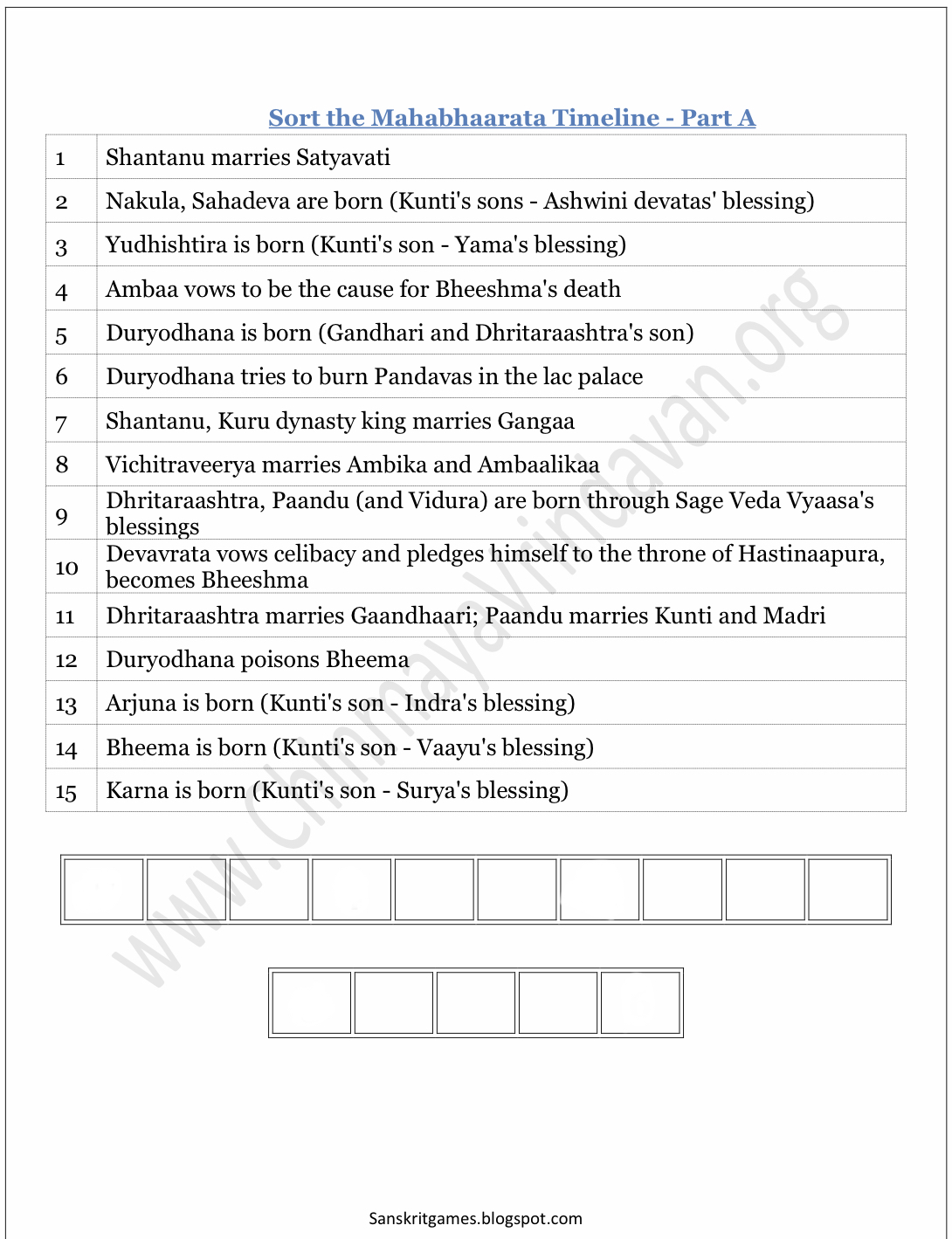
Our first activity was about the Mahabharata Number sequence.  There were two parts - Part A and Part B. A sample of Part A sequence is given below.


The second activity was about the Mahabharata Picture sequence. There was a jumbled slide deck. The kids were supposed to make a copy of this and then sequence it together. (https://docs.google.com/presentation/d/1mydsp55zpWZ-TWqjkL646oW3lFMnS2f07UbzxE6in-w/edit?usp=sharing). 


The class did these activities very well. They were discussing amongst themselves to fill in the gaps of their understanding and stitched the story together. They also enjoyed it a lot and told us that they would like to have more such activities. They finished both the assignments in the class itself. However, we have asked them to review the second activity with their teams. We plan to give them the answer key for this in the upcoming class. 


Pranams, 
Partha and Nikhita 

Jan 24, 2021 - Grade 8 (Sunday PM)

Hari Om All, 

We started with the Yaksha Prashna Kahoot quiz based on what we covered last week. We also did some Yaksha prashna before and after the class. This week we talked about some important people in the Kaurava camp.


Bheeshma is one of the most important people on that side. He had taken a terrible oath and to fulfill that he stayed faithful to Hastinapur. Even though he is knowledgeable about Dharma there were instances where he deviated from Dharma. It is said that these adharmas were the arrows that poked him as he lay on the bed of arrows. Swami Chinmayananda says he is the real Hero of Mahabharata, as the story starts with him and ends with him. He is one of few people who really understands the divinity of Shri Krishna. We talked about his relationship to Arjuna. We talked about how it is difficult to identify great people and what it means when great people are themselves calling other people great. 


Dhritarashtra means "holding on" to "nation". He became a ruler after Pandu left for the forest and died. He has an excessive "blind" attachment with Duryodhana. He knows what is right or wrong but still does not choose right. He keeps bad company with people like KaNik - gets attached to bad advice and follows it blindly. He has a choice in following Vidura's advice but does not follow that. He could have stopped the great Mahabharata war but due to his own weaknesses he does not. 


Gandhari is married to the blind king Dhritarashtra, and decides to tie a blindfold herself to follow his fate too. She asks for 100 children. We talked about the choice we should make between choosing quality over quantity. Being able to follow the right path is all that is important since everything is temporary. She attempts to give advice to her sons but they ignore her advice. After the Mahabharata war, when all the Kauravas are dead, she and Dhritarashtra retire to the forest where they are killed in a forest fire. 


Shakuni is the brother of Gandhari. He is instrumental in making Kauravas behave worse. He helps them in cheating in a game of Dice. It is said that Shaukini vows to seek revenge because his sister got married to the blind king and she lives the life without sight. 


Duryodhana and Dusshasana are the oldest of Kaurava brothers. Duryodhana is a bad influence. His jealousy and greed affects his brothers too. They follow Duryodhana loyally and get affected negatively. Dusshasana incurs destruction on the entire Kauravas when he pulls Draupadi's saree. 

We talked about how we should focus on following Dharma over other aspects like blind Loyalty. In this case, loyally following a bad influence destroyed all Kauravas. 


Dronacharya is the great guru of the Kuru princes. He was humiliated by Drupada, who was his friend at Gurukula. We talked about how and why a brahmin became a warrior and a tutor for money for the Kuru princes. He became a slave of money because of his attachment to his son. His attachment got him working for the king and the same attachment becomes the reason he died. 


Kauravas in general are the negative traits and Pandavas in general are the positive traits. The battle between these traits is the Mahabharata. These traits are all around us in the society we live in. In fact, we can think of this happening inside us all the time. We need to introspect, identify the right path and follow that intently. If we follow this Dharma, Krishna is with us and victory will follow. Even though there were great leaders in Kauravas, even though they knew the truth in their conscience, they could not rise above their weaknesses, attachments and ambitions. They then got destroyed. 


Kauravas were in constant conflict with each other because of these weaknesses. 


The lesson for us to be aware of this and follow the path of Dharma unflinchingly. 


In the next class, we plan to do an activity for sequencing the Mahabharata events. 


Pranams, 
Partha and Nikhita 

Jan 10, 2021 - Grade 8 (Sunday PM)

Hari Om All, 


This past class we 'graduated' from recapping the Mahabharata to diving deeper into the main characters of the epic, specifically the Pandavas. Our goal is to now understand their individual characteristics and apply the good values we can learn from them into our own daily lives. 


We started off the class with Yaksha PrashNa questions. 

Upon explaining specific situations and discussing those, we delved into our lesson on the Pandavas. The characters that were analyzed were Kunti, Yudhishtira, Bheema, Arjuna, Nakula & Sahadeva, Draupadi, Abhimanyu, and Parikshit. 


Main points about the characters :

1. Kunti 

Daughter of Shurasena, adopted by King Kuntibhoja. Kunti was one of the greatest devotees of the Lord. All her children were born of celestial deities due to the secret mantra given to her by Rishi Durvasa. Karna, her eldest son was raised by a charioteer's family. Married Pandu and gave birth to the Pandavas. Her one greatest flaw was not telling Karna that he was her son until the very last minute. History could have been different if she had told him sooner! Arjuna and Karna's rivalry would have not existed. 


2. Yudhishtira 

Yudhishtira is the eldest of the Pandavas. He is known as DharmarAja (the King of Righteousness). 

The students were told about his virtue of always telling the truth through a story. Moral of the story was : Learning a lesson is not just memorizing it, but actually using it in your life.

Another story about the wee end of the Mahabharata was taught. After everything, at the end of their lives, the Pandavas made their final trip up the Himalaya mountains. The trip was very strenuous and one by one, the Pandavas 'fell' and did not make it to the top. The only members who reached the very top were Yudhishtira and a loyal dog who had been following him throughout the journey. They were met by Indra at the top who told Yudhishtira he was ready to go to heaven. However, Indra made it clear that there was no place for a dog in heaven and so only Yudhishtira could enter the carrier chariot. Yudhishtira, being a DharmarAja, was adamant and said he would not go anywhere without the loyal dog. The dog turned out to be the actual form of DharmarAja and welcomed Yudhishtira to heaven!! The lessons learned here are to always live by Dharma, have the attitude of gratitude, and understand that God is in and through everyone.

While he has an abundance of good qualities, Yudhishtira's one weakness was gambling/playing dice. We can see how even one small weakness ends up as a disaster when one crosses the limit!


3. Bhima

Born through Vayu and the strongest of all the brothers. There are innumerable stories of his bravery and strength from when he was a small child until the end. Has killed many great Kaurava warriors such as DusshAsana and Duryodhana. 


4. Arjuna

Born through Indra and the youngest son of Kunti. Was the most gifted and favorite student of his teacher, Dronacharya. It was he who won the hand of Draupadi by completing the challenge at her svayamvara. He was an outstanding warrior and Krishna's favorite. Krishna recited the Bhagavadgeeta to him. 


5. Nakula & Sahadeva

Born through Ashvini Kumaras (the divine physicians). Nakula was gifted in Ayurveda, horse keeping, and swordfighting. Nakula was the most knowledgeable amongst his brothers, was skilled in astrology, swordsmanship, and axemanship. 


6. Draupadi

Daughter of King Drupada of PanchAla. Wife of all 5 Pandavas, won by Arjuna at her svayamvara.


7. Abhimanyu

Heroic son of Arjuna and Subhadra. Married Uttara, daughter of King Virata. Bravely entered ChakravyUha (a complex, circular battle formation) on the 13th day of battle but could not come out. Was killed through unjust means by the Kauravas. 


8. Parikshit

Posthumous son of Abhimanyu. Saved by Krishna when Ashvatthama attempted to kill him in the womb through use of the BrahmAstra. Went on to rule Hastinapura for over 20 years. 


We ended the class with more Yaksha Prashna. 


Lots of material covered this class! Next class will focus on analyzing the Kauravas and their qualities and learning what not to do in our daily proceedings. 


Looking forward to another fun filled class next week. Students, please keep your awesome questions coming!


Regards, 

Nikhita & Partha. 


Dec 20, 2020 - Grade 8 (Sunday PM)

Hari Om All,


Summary of Dec 20, 2020 Class.


We did a recap with Kahoot questions and reviewed the answers. 

We continued this week with the episodes from pandavas in exile. The thirteenth year was the year in exile. They all decided to stay in king Virata's kingdom. Yudhishtara became Kanka. Bheema became Vallabha. Arjuna became Brihannalla, Nakula became Granthika, Sahadeva became Tantrika and Draupadi became Sairandhri. 

Keechaka was a strong arm in the kingdom who was feared by all the neighboring kingdoms. He is killed by Bheema when he attempts to bother Draupadi (Sairandhari). We reviewed the "Cause & Effect" scenario of how Keechaka gets tempted to do wrong things and gets punished as a result. 


Soon after Keechaka's death, Kauravas suspect that there is a chance of pandavas to be in the Virata kingdom. So, the Kaurava army is split into two groups. Susharma's army attacks from the south first. Virata and his armies get ready to face them. Later, the rest of the Kaurava army attacks from the North. Uttara Kumara (King Virata's son) takes Brihannala to face this part of the Kaurava army. In the battle, Brihannala reveals himself to the Kaurava army and puts them under the spell of Sammohana astram. Later, the true identity of Pandavas is revealed to king Virata. 


When the pandavas want their share of kingdom or atleast 5 towns, the Kauravas refuse. Duryodhana does not even want to give land that occupies the tip of the needle. The war was imminent now. Arjuna and Duryodhana both go to Shri Krishna to ask for his and his armies help. We discussed the episode where Arjuna stands waiting at Krishna's feet and Duryodhana is at Krishna's head. Krishna asks for Arjuna's choice first since he saw him first. Arjuna asks only for Krishna to Duryodhana's glee. Duryodhana gets all of Krishna's armies. 


The battle began soon after. 

We did some shlokas from Yaksha Prashna. The students will have a quiz on Yaksha prashna before this year's sessions ends. 

We continued the session with the happenings in the war. Bheeshma on the 8th day destroyed a large chunk of the Pandava army. Krishna then advises Pandavas to go and see the blessings of Bheeshma. Bheeshma blesses pandavas to be victorious. Bheeshma then narrates that he will not fight a woman. Under Krishna's advice, Shikandi was kept in front of Arjuna and Arjuna shot a shower of arrows at Bheeshma. Bheeshma fell down on the battlefield. Arjuna then gives him a head rest with arrows and quenches the thirst by shooting an arrow in the ground. At this point, Bheeshma narrates Vishnu Sahasranamam. 


We talked about how Abhimanyu negotiated the chakravyuha but could not come out. He died valiantly. Krishna helps Arjuna to kill Jaydratha soon after to keep his vow. 

Drona was very attached to his son Ashwathama. Bheema kills an elephant called Ashwathama. Yudhishtara then says a half-truth that Ashwathama has been killed. Drona is made to think that his son is dead. Drishtadyumna then kills Drona. 

The battle continues till Kauravas are killed. When the battle ends, Gandhari curses Krishna. She thinks he is the cause of all the destruction. Krishna explains that this was because of the bad upbringing that made Duryodhana an evil person. And she was responsible for this. 

Kunti then revealed that Karna was her son. 

We did a number of analyses with respect to cause and effect analysis on these topics covered. Some of them are Reverence to elders and Grandfather's secret (with respect to Bheeshma), Gandhari's Curse etc.


Pranams,

Partha & Nikhita


Dec 13, 2020 - Grade 8 (Sunday PM)

Hari Om All,


Summary of Dec 13, 2020 Class.


We started off with Draupadi Swayamvara at Kaampilya. The pandavas attended this Swayamvara disguised as Brahmins. The challenge was to shoot a rotating fish suspended in a device that was rotating high above a pond by looking at its reflection in the pond. There were 5 arrows to be used and a bow to be strung before anyone could shoot. There were many able kings like Shalya, Shisupala and Jarasanda who tried but failed. Karna also attempted but was rejected by Draupadi even before he tried. Eventually, Arjuna was able to succeed in the challenge and win Draupadi.
We did an exercise to discuss why Arjuna was successful. The hardwork, intense practise and focus was what made him successful. 

Later, when pandavas came back to Kunti with draupadi. There was a discussion also held about how Kunti asked pandavas to share whatever they got without looking. The lesson we need to derive is to look before saying anything.

Soon after, everyone came to know that pandavas were alive and won draupadi. Dritarashtra decided to give pandavas some ruins (kandharaprastha). Pandavas converted this into a prosperous city - Indraprastha. Yudhishtara also did a big yajna called Rajasuya yajna. Seeing this prosperity Kauravas decided to trap them with a game of dice. Pandavas lost their entire kingdom and themselves in the dice game. They also lost Draupadi. Draupadi was insulted in the assembly and none but Krishna saved her when she needed it. We discussed that it is calamitous to insult a woman and why she was a "Karan Janma" -  born with a purpose to destroy Kauravas (Evil). The pandavas were then freed. We also discussed the pitfalls of Gambling. 

The pandavas were trapped again in a game of dice. They were then sent to an exile for 13 years. We started the story of Yaksha prashna. 


We did Geeta chanting for the day. 


Pranams,

Partha & Nikhita


Dec 6, 2020 - Grade 8 (Sunday PM)

Hari Om All,


Summary of Dec 6, 2020 Class.


The class resumed after a long break. We started with how Ganga and Shantanu met. Ganga leaves when Shantanu stops her from killing the 8th Vasu reborn. So, Devrata is born and Ganga takes him away. Later, when Shantanu is enamoured by Satyavati, a fisherman's daughter, Devrata takes a vow to remain celebate throughout and becomes Bheeshma. Two sons are born to Satyavati - Chitrangadha and Vichetraveera. Chitrangadha gets killed by another gandharva by the same name. Vichetraveera is crowned king. Bheeshma wins over Kashi princesses Ambika and Ambalika for Vichitraveera but Vichetraveera died childless. As per the traditions followed by kings of those times, Ved Vyas (Krishna Dwaipanya) is called to help give children to Ambika and Ambalika. (if you recollect, Ved Vyaas was born to Satyavati and Parashar Rishi ). Ambika closes her eyes and Dritarashtra is born to her. Ambalika becomes yellow with fear and Pandu is born to her. A maid gives birth to Vidura. 


Later, Pandu becomes the king. He is married to Kunti and Madri. He is cursed by a rishi and decides to leave the kingdom. Dritarashtra is made the caretaker king. He gets married to Gandhari. Soon, Kunti gives birth to Yudhishtara, Bheema and Arjuna. Madri gives birth to Nakula and Sahadeva. 

Meanwhile, Gandhari gives birth to 100 sons and 1 daughter. 

Pandu dies because of curse and Madri too decides to give up her life. Kunti with the pandavas are taken back to Hastinapur. 

Pandavas and Kauravas are both trained together. Bheema is the strongest of them all. Duryodhana becomes jealous of them and tries to kill Bheema.
We discussed Duryodhana's evil nature and what makes him evil and how pandavas progressively become stronger by following Dharma. 

We discussed the law of Karma and how it will affect everyone.
This evil nature makes Duryodhana trap pandavas in a Wax(Lac) palace. Pandavas escape this and burn the palace themselves. 

We discussed the symbolism of the Lac palace. (All that looks beautiful is not necessarily good). 

We did our regular geeta chanting.


Pranams,

Partha & Nikhita